Tradional Usage
  tar {A|c|d|r|t|u|x}[GnSkUWOmpsMBiajJzZhPlRvwo] [ARG...]
It is invigorating.
If like me you have no memory, use aliases.
Put them in a dedicated file, I find it easier to manage. You’ll need to modify bashrc or zshrc to link to the new file. Big plus, they now work with both. I don’t know if it can be done with fish.
Now my favorite tip for us brainless: start aliases with an easy to reach character you most likely wouldn’t use in a terminal. I use “é”, on a french keyboard.
é+tab: all my aliases é+t+tab: I see “étarextract” (there it is), “étext-edit”, “étodo”
I don’t even need to remember aliases. I don’t need to remember anything!
Imathop out.Honestly I just create and extract. I don’t use most of the options. But, I had a lead about ten years ago dare me to create and compress a .tar.gz directly without looking it up and I was most of the way through typing it by the time he finished talking. He looked at me like I was doing black magic.
That would work if it was find instead of tar.
of course I know it, it’s
tldr tarIt’s pretty simple
tar
 e[x]tract
 [z]is
 [f]ile
 [v]erbosely
archive.tar.gz
--directory=archivedir
For creation it’s pretty much the same but you need to specify [c]reate, e.g.
tar czvf archive.tar.gz filestoarchive/and for lis[t]ing it’s -tar tf archive.tar.gzv stands for “vocking”, tar -xzvf is the intended use
tar [t]he [f]uck am_i_looking_at.tar.gzThat mnemonic is misleading if it’s not gzipped, and unless you’re untarring a stream from a pipe or over a network, you don’t need to tell
tarwhat compression was used when extracting, it knows.True, it’s just easy to remember.
Talk to me when you
ffmpegby heart 😭i wish i could get ffmpegged
I was just wondering why that sounded dirty, then I saw your follow-up comment.
I never ffmpegged you for a pervert. 🤷♀️
guy getting bred by two girls call that ffmpreg
I’m just glad that ffmpeg is smart enough when converting audio that all you need to do is pass the input and output.
ffmpegis always funny to me, because it feels like you could convert anything into anything, if you just knew the right flags, but 99% of my use is extracting a clip out of a video file.And the command for that is in my shell history, so I wouldn’t know the flags either. ¯\_(⊙ʖ⊙)/¯
HAH! I know!!! The “correct” flags are always:
Ctrl + r 'ffmpeg'an undefined amount of times 8D
Alright alright, I’ll get you the moon you wanted.
This comment got my brain stuck in an infinite loop: there’s a rabbit on the Japanese moon, there are tons of moon themed jazz songs, the moon is cheeze, moonshine, moon rhymes with boon, Moon River is a beautiful song, Kame-sennin blew up the moon to make Son Goku revert to his human form, Moonraker was only “meh…”…
I still don’t get it. WHAT does this expression mean 😭
To “ask for the moon“ is to make an unreasonable request. The comment is a play on that saying. In this context, it means, “I’ll do the impossible”
Exactly this. It only occurred to me because, “Talk to me when […]” sounds exactly like a partner or significant other would say.
So… Does this mean you did in fact learn to
ffmpegby heart to any extent? 🤣I actually did have to learn a little bit for some videos I had, but now it is all gone.
Lemmy got an Ai hate boner but this is the first thing zi ever really used it for that wasn’t research. “Give me the corrct ffmpeg command for _ and explain every flag concisely.”
While I wouldn’t use AI myself for ehtical, environmental and detrimental reasons, I also don’t judge anybody that does. Just make sure to vet the information on your own too! 😊 What did you use ffmpeg for BTW?
It’s very clutch in general when you need a smaller file size or different format.
Converting my blender videos to smaller sizes for tiktok/ig to avoid their compression. I eventually just started going for smaller 15second vids, don’t usually have to compress and I’m not making money either way. Was pretty useful tho, I saved one command and would just swap the names of the files, used it on my iphone through A-shell quite a bit.
Not to mention imagemagick. I can often get ffmpeg to more or less do what I want on the first try, but imagemagick always results in a second try after reading the documentation for the 938th time.
For the magick stuff I do all the time (you all know what it is) I prepared a script. I wrote it probably a couple of years ago by this point and even if you held a gun to my head and I had it open in the text editor in front of me I couldn’t explain to you what all the flags and arguments actually do.
Ahahaha I feel you. My ffmpeg scripts are similar: they work, but GOD knows why. I should print the manual and read before bed.
Condolences on never sleeping again.
Or, perhaps, congratulations on falling asleep right away.
I got it, mostly… The various filter chains, not so much. But I can map input streams and set dispositions and metadata, and know a bunch of svtav1 passthru params by heart; with enough experience to set pretty decent crf/preset/filmgrain-synth settings by eyeballing the input (ofc specifics depends on the video encoder and whether or not I’m using something like the psyex/hdr fork…)
Some people look at this as wizardry, but it’s really not too hard once to get the hang of ordered arguments… Like whether or not you put -ss before or after -i changes the seeking behavior… Okay, it’s a little wizardry.
You say
not too hard
I say

I mean, I at least know the simple stuff like transcode (with hw accel), scaling and trimming by heart, but filters? Hell no
Same here. Except I have only learned how to encode with
x264for now, without hw accel because learning the (in my case) nvenc switches and options is a whole other chapter…
I just remember running the coolest ffmpeg command many years ago, I don’t remember the actual command, but it rendered th video as ascii art
Shut. Up. That sounds amazing. Did it convert the video data into ASCII text or did it use ASCII characters to resemble the actual video?
It was a very long time ago, I ran it on my Dell Latitude E5400 with a Core2Duo, just so you get an idea of the era we are talking about.
I recall it worked like this script:
https://github.com/pzich/ffmpeg-ascii
I remember testing it out with a Futurama episode.

I was going to use this opportunity to shill for tldr by linking directly to their page on
tar.But I just realized
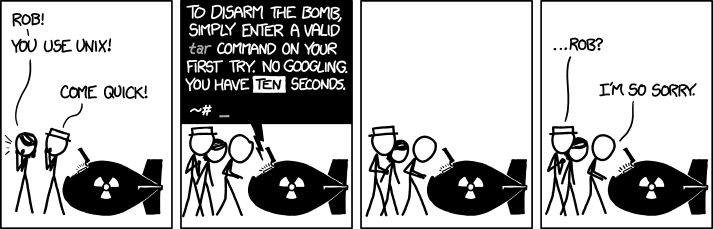
tar’s reputation is so bad, they use it as the example on tldr’s homepage. 😂
This pic shows perfectly that one only ever needs six flags, of which two are always used. So what remains to remember is ‘c’ or ‘x’ and ‘j’ or ‘z’.
I was gonna say, my knowledge of tar and ffmpeg (and god knows how many other progs) is basically limited to what’s on tldr.
Homepage? That should totally be a Linux command alongside --help, and man.
It is; I use it all the time!
https://github.com/tldr-pages/tldr/wiki/Clients#console-clients
for me it’s remembering whether I wanted
addgrouporgroupaddSysadmin here. I still fuck up on a regular basis.
Again this old myth that using
taris possible without looking up commands every time. It’s been debunked many timeseXtract Ze File
xzvf or nothing
but how am i supposed to remember that?
eXtract Ze Vucking File?
e[x]tract; g[z]ip; [v]erbose; [f]ile
Reordered, and we can have [v]erbosely e[x]tract g[z]ip [f]ile, or
tar vxzf [file]I find it more difficult to remember other options. Might stick better if pronouncing the g in
gzipsimilarly as GNU insists GNU be pronounced, with a hard g—never really tried it, but sounds a little funny. Actually, I think I first remembered it as g sounding like the, making for extract the zip file, but with a soft g; I felt the former put too much emphasis on a letter not used as an option.eXtract Ze Vucking File?
Ja mein freund.
I saw tar -xvf 13 years ago and have been using it ever since.
Tar (some versions at least?) is actually smart enough to detect which format to use based on file extension of the output, so you don’t need to remember which flag corresponds to which compressor. Examples:
tar -caf archive.tar.xz [files]
tar -caf archive.tar.bz2 [files]

# extract
tar -xf archive.tar.xz
tar -xf archive.tar.bz2
So you really only need to remember that
cmeans create,xmeans extractI mean…
tar -cf hello.tar
or tar --help
Why is everyone always going in about tar? I never saw the issue with it, its not more or less complicated than other commands that take command line flags…
For example: sudo netstat -peanut, where -peanut actually expands to -p -e -a -n -u -t. I don’t have any idea anymore what each letter stands for while I do recall that tar -cjf file.tar * is -c create, -j bzip2 compression and -f filename