

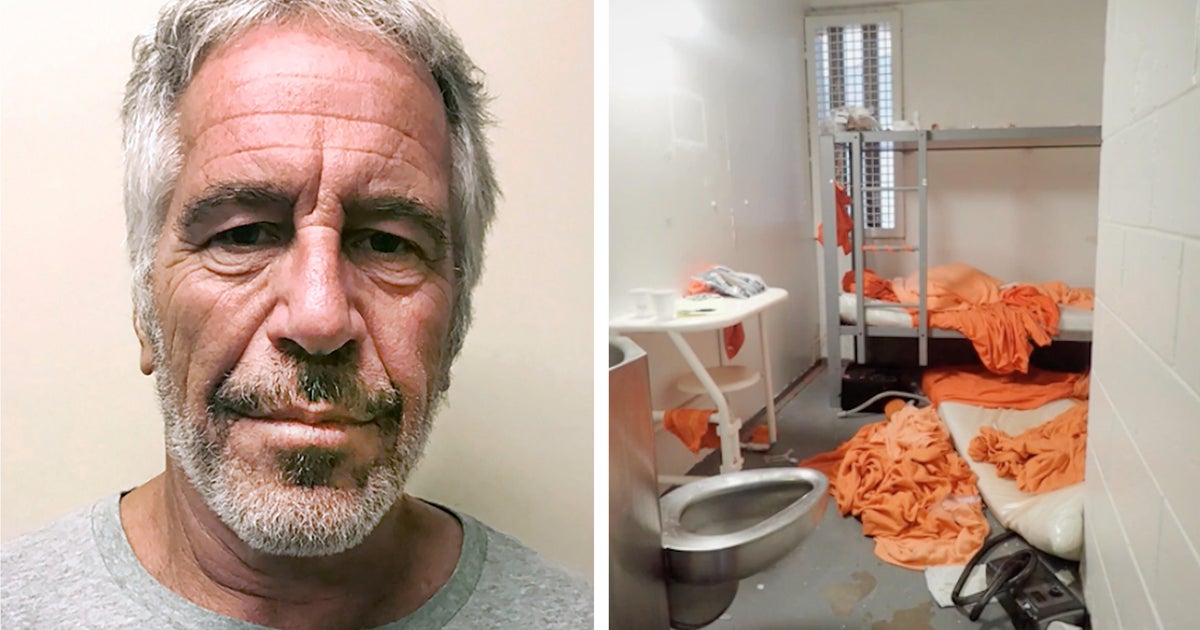
Across the political spectrum, a large chunk of Americans believe, despite a lack of evidence, that Jeffrey Epstein did not die by suicide.
Now one forensics expert, working with photos and files provided by Epstein’s brother, is weighing in to contend that this suspicion might be right.
Dr. Michael Freeman, who is editor-in-chief of the Journal of Forensic and Legal Medicine, spent months reviewing never-before-published autopsy records provided to him and CBS News by Epstein’s brother. The 2019 ruling by the the New York City Office of Chief Medical Examiner was that Epstein died by suicide. But Freeman has concluded that Epstein’s death was more likely a homicide.
Freeman — who worked with Anders Eriksson, a professor of forensic medicine at Umea University in Sweden, and Itiel Dror, a researcher specializing in identifying bias in forensic decision making — presented their findings Monday in London. Freeman said he believes that in August 2019 the world’s most notorious sex abuser was likely attacked and killed by another person.
That’s called a keloid. It’s an abnormal type of scar.
Those who have ancestry from Sub-Saharan Africa, Asia, or Latin America or if you have family who have them are more likely to develop them, as susceptibility is somewhat genetic.
It seems more likely to be lividity than keloid scarring.
Lividity is the reddening of the entire ear and back of the head. We’re not talking about the color of the skin, we’re talking about the mishaped aspect of the earlobe, which looks malformed likely due to a keloid scar.
Or it could just possibly be he had some danglers for earlobes and the position he is laying in just has it folded all funky now that I apply Occam’s Razor.
Lividity indicates the distribution of blood under the skin around the point of death. If he died with sufficient compression on the earlobe it would not fill back up with blood after his heart stopped and the skin and blood vessels relaxed after rigor.
I was wondering if it was indication that a ligature had passed behind his ear, but you’d think there would be more evidence on that side, on that side. People that hang themselves in prison (not saying that that is what I think happened) don’t tend to hang themselves off the ceiling so they’re swaying. They tend to tie themselves to the bed and lie down so they are suspending the weight of their upper body on their neck, which will put you in a slumped and crumpled position, pulling your head against a surface.